Co-founder, CEO for 33 years. The company’s public face since 1993.

PC Hardware · GPUs · Corporate Upheaval
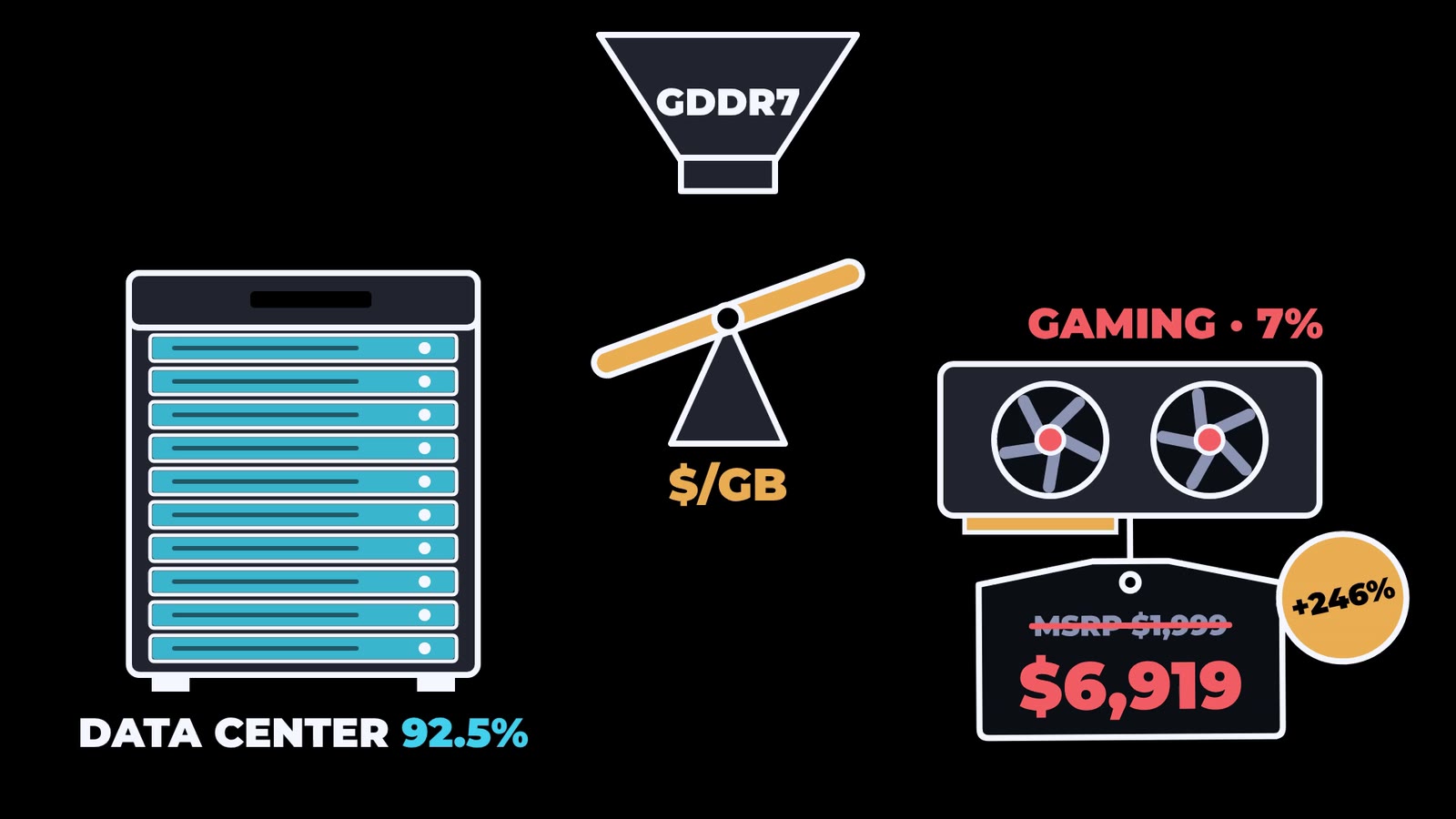
Gaming is now about 7% of NVIDIA’s revenue and no longer even appears in its earnings report by name. The founder who still treated GeForce as the company’s soul is gone, replaced by a CFO with a margin mandate, five days before the quarterly call.
NVIDIA’s board announced Thursday morning that Jensen Huang had resigned as president, chief executive, and board member, effective immediately, five days before the company reports its third-quarter fiscal 2027 results on Tuesday, November 17. The transition notice names Colette Kress, NVIDIA’s chief financial officer since 2013, as interim CEO, and gives the board its first-ever chair, Harvey C. Jones. The same statement promises that “operations, customer commitments and product roadmap” continue without interruption.
The question that matters for anyone with a GPU purchase pending is what happens inside a company where gaming has become a rounding error, at the exact moment the company stops being led by the one person whose identity was tied to selling graphics cards to gamers, and starts being led by the person whose job is to wring the most dollars out of every gigabyte of memory NVIDIA buys.
We followed the scandal reporting closely enough to summarize it in one section below.
Huang’s exit follows two weeks of cascading revelations. On November 8, after the New York Times reported that U.S. intelligence officers believed a woman he had been seeing, Alice Huang, was an asset for Chinese intelligence, Huang admitted he had been “unfaithful” to his wife. The board opened an independent investigation that day, saying Huang had been “the target of a foreign intelligence effort” and that it “prioritizes U.S. national and economic security,” while also expressing confidence in him to stay.
Three days later, reports of a second relationship, this one with Kimberly Powell, a longtime NVIDIA executive who reported directly to him, broke the board’s support (BBC, citing U.S. media), and Huang resigned Thursday. Shares fell as much as 14% at the open and closed at $166.19, down 4.34%, wiping roughly $181 billion of market value in a single session (Yahoo Finance; MarketWatch counted close to $200 billion). Over the five trading days since the story broke, NVIDIA has lost about $550 billion, its worst five-day drop since going public 27 years ago, and briefly traded below the $4 trillion mark.
The espionage allegation is exactly that, an allegation: CNN reports that U.S. officials disagree about the strength of the evidence that Alice Huang, an executive at Singapore-based Megaspeed, worked for China’s Ministry of State Security; Attorney General Todd Blanche says the DOJ has drawn no conclusions, and Beijing calls the claim a smear. And Huang’s side has said he supports the review and cooperates with it. The part that matters for this article is what the scandal set in motion, and that is documented regardless of how the underlying accusations resolve.
In the quarter that ended July 26, NVIDIA reported $96.2 billion in revenue, up 106% year over year. Data center produced $89.0 billion of it. The entire remainder, every device that sits on or under a desk, lives in a single segment the company calls Edge Computing: PCs, game consoles, workstations, AI-RAN base stations, robotics, and automotive together, for $7.2 billion.
Note what is missing from that list of sub-markets. There is no gaming line. Starting with fiscal 2027, NVIDIA folded its Gaming segment into Edge Computing, which means there is no longer any way to tell from the filings how much revenue GeForce GPUs or console chips generate. TweakTown went through the Q2 report and found it does not mention GeForce, RTX, or gaming at all. The word does not appear in the last earnings report Huang signed.
For scale on the demotion: in fiscal 2026, gaming GPUs generated $16.0 billion, or 7.4% of a record $215.9 billion, and that already counted as a down-in-importance year, with total graphics (including workstation cards) at 11.45%. The company was founded as a graphics processor maker. Thirty-three years later, gaming earns less in a quarter than its data center arm earns in a week.
Huang knew the squeeze was coming and said so himself. In February, warning that gaming hardware supply would be tight, he told analysts: “As much as we would love to have more supply, we do believe for a couple of quarters it is going to be very tight” (Tom’s Hardware). Even with him in the chair, GeForce was losing the allocation fight. He was the argument in the room for still shipping consumer cards at all.
Colette Kress joined NVIDIA in September 2013, when the company made about $4 billion a year, and has run finance through the climb to $216 billion (Yahoo Finance). Before that: nearly 25 years in finance roles at Cisco and Microsoft. She has delivered the CFO commentary on every earnings call for a decade, which is why the board picked her for the interim slot five days before one: Wall Street gets a familiar voice (Constellation Research). The 8-K lists her fiscal 2026 compensation as CFO at $14.3 million against Huang’s $36.3 million and adds nothing for the interim role (Nationale).
The Information describes her as having “tried to tame NVIDIA’s riskiest bets.” That disposition, plus the board’s own mandate of continuity, points one direction: the business that just returned about $26 billion to shareholders in a single quarter through buybacks and dividends will be run for its balance sheet first.
Co-founder, CEO for 33 years. The company’s public face since 1993.
EVP and CFO since September 2013. Interim CEO since November 12, 2026.
Electrical engineering. Built product culture around game launches, GTC keynotes, and the RTX brand.
Nearly 25 years in finance at Cisco and Microsoft before NVIDIA. Ran the finance organization.
GeForce was his origin story. Consumer launches were his stage personally.
None on record. Her public record is earnings commentary, margins, and buybacks.
Market creation: CUDA, AI inference, and keeping GeForce culturally alive even at 7% of revenue.
Capital efficiency: 75% gross margin, $26B returned to shareholders last quarter, risk tamed.
n/a
Board: operations, customer commitments, and roadmap “continue without interruption” while a permanent CEO search runs.
When memory is scarce, allocation decisions get made on return per component, and Tom’s Hardware reports that NVIDIA is already allocating memory “based on the amount of money it can make per GB of VRAM.” A finance-led NVIDIA applies that formula more consistently. Gaming GPUs win that formula only when gamers outbid data center buyers for the same chips, and right now they do not.
The clearest casualty predates the scandal. The RTX 50 Super refresh, planned as a VRAM bump to 18GB on the 5070 Super and 24GB on the 5070 Ti and 5080 Super, missed CES 2026 and was then “delayed indefinitely” in January, which TweakTown translated as company-speak for cancelled. Board Channels sources pointed to 3GB GDDR7 dies costing around three times what 2GB dies cost and AI demand consuming GPU production, while the absence of new AMD Radeon cards in 2026 removed any competitive reason to ship them. Reporting this month says the cards are physically built and sitting at board partners, ready for a launch that has no date.
Huang might have let an indefinite delay stay a door left open, with the refresh shipped as a goodwill play once memory costs cooled. Under an interim CFO five days out from earnings and hunting a $108 billion quarter, the same delay is more likely to harden into a quiet cancellation, with the wafer capacity redirected where the per-GB math wins. TweakTown’s own read: with the RTX 60 and Radeon RX 10000 series due in the second half of 2027, a mid-cycle refresh this close to a new generation barely makes sense, and the memory crisis could push the Super into 2027 and the next generation into 2028. Our September piece on the hardware drought landed on the same window from the supply side.
Meanwhile, the cards you can buy keep repricing upward.
And November brought another round. Chinese board partner Colorful raised cost prices across its RTX 50 lineup, per supply-chain reporting: +$380 to $450 on the RTX 5080, +$150 on the 5070 Ti, +$90 to $135 on the 5070, and +$15 to $30 on entry models (Wccftech, November 3). GALAX followed with at least 200 yuan across models from the 5060 up. A week later, a rumored MSI schedule had the RTX 5080 drifting toward $3,000 and the 5070 Ti toward $2,000 in worst-case scenarios (TechRadar, November 10; a rumor, but consistent with every prior hike landing). NVIDIA’s own store has already delisted the RTX 5090 and then the 5080, per retailer-channel reports, and manufacturers have started steering buyers toward older parts like the RTX 3060 as the value option.
| Model | November cost-price hike (Colorful) | Worst-case rumored next step (MSI) | Current lowest U.S. street |
|---|---|---|---|
| RTX 5090 (D v2) | +$330 to $550 | n/a (delisted at NVIDIA store) | $6,919 |
| RTX 5080 | +$380 to $450 | toward ~$3,000 | $1,999 |
| RTX 5070 Ti | +$150 | toward ~$2,000 | $1,399 |
| RTX 5070 | +$90 to $135 | +$75 to $150 | $899 |
| RTX 5060 Ti 16GB | +$37 to $60 | ~+$50 | $769 |
| RTX 5060 8GB | +$22 to $30 | ~+$50 | $449 |
The national-security dimension is already generating hearings, and export-control episodes have a documented history of reshaping what consumers can buy and pay.
Senator Tim Scott has asked Huang to appear before the Senate Banking Committee on December 3, with a subpoena threat attached, and three House committees want him in closed session on December 1 (BBC). Commerce Secretary Howard Lutnick was summoned to the same committee over reports from administration officials that he stalled efforts to tighten export restrictions on advanced AI chips to China. The board’s own November 8 statement, with its line about prioritizing “U.S. national and economic security,” tells you which side of that pressure NVIDIA intends to stand on.
The historical precedent matters because it shows this is not speculation about motives. When the October 2023 export rules landed, NVIDIA shipped a China-specific RTX 4090D with reduced specs, and when the H20 ban landed in April 2025 it took a $4.5 billion inventory charge in a single quarter. Every tightening episode so far has been absorbed partly by consumer product strategy, and the coming hearings guarantee the subject stays in the room through at least the spring.
One of the cases below sits uncomfortably close to this one.
| Company | Exit | Who took over | What happened to consumer products |
|---|---|---|---|
| Intel | Brian Krzanich resigned June 21, 2018 after an investigation found a past consensual relationship with an employee | CFO Bob Swan, interim first, then permanent | Consumer CPUs stagnated through years of 14nm refreshes while 10nm slipped; AMD’s Ryzen took share through the exact window of the CFO-led transition (Intel release, CNBC) |
| Apple | Steve Jobs resigned August 24, 2011 for health reasons | Tim Cook, operations and supply-chain background | Cadence held and prices climbed: the Cook era systematically moved the lineup upmarket, with flagship iPhone prices rising generation over generation |
| Microsoft | Steve Ballmer announced retirement August 2013, stepped down February 2014 | Satya Nadella, enterprise and cloud background | Consumer hardware got cut: a $7.6 billion write-down on the Nokia phone business in July 2015 and a wind-down of Windows phones; investment concentrated where the margins were |
Consumer lines survive a leadership vacuum only while they are margin leaders in their own right. Intel’s CPUs were, until AMD made them not. Microsoft’s phones never were. Apple’s hardware was, so it stayed but got pricier. GeForce entering a transition with gaming at 7% of revenue, its refresh cancelled, and its memory being allocated by dollars-per-GB, is closer to Microsoft’s phones than Apple’s hardware.
NVIDIA reports Q3 FY2027 results at approximately 1:20 p.m. Pacific on November 17, with the call at 2 p.m. It will be Kress’s first as the voice of the company, and what she says about GeForce, memory supply, the CEO search, and China will carry more weight than any headline between now and then:
Treat everything below as the reading of evidence: nobody, including NVIDIA, knows who runs the company in six months.
The RTX 50 Super is not worth waiting on. The refresh was already delayed indefinitely in January over 3GB GDDR7 costs, with no competitive pressure forcing its return and a next generation penciled for the second half of 2027 at the earliest. A leaderless, finance-led NVIDIA in a memory crisis has every incentive to formally shelve it and none to ship it. If a card you would have bought is only worth buying as a Super with more VRAM, plan around the existing lineup or wait for the 2027 generation, and assume that generation can still slip into 2028, as we laid out in our hardware drought analysis.
If you need a card in the next six months, earlier beats later. Price hikes have landed every month this year, November’s are already in effect at board partners, and the rumored December wave aims higher at the 5070 Ti and 5080 tiers. This is the same logic as our Black Friday timing piece. The resignation only strengthens it, since the one person likely to push back on consumer price discipline is gone.
The value zone is the low-VRAM end of the lineup. Low-VRAM SKUs are the ones closest to MSRP right now: the RTX 5060 at $449, the 5060 Ti 8GB at $499, and Intel’s Arc cards holding the budget slot AMD and NVIDIA have abandoned. The high-VRAM cards (5070 Ti, 5080, 5090) carry the largest crisis premiums, between 87% and 246% over MSRP, precisely because their memory is worth more to NVIDIA somewhere else. Pair whatever you buy with the RAM and storage realities from our RAM forecast analysis and the NAND sellout, since a cheap GPU inside an expensive build is still an expensive build.
If you own a current card, its resale window is wide. Street prices running double MSRP mean used cards trade high too, and nothing in this week’s news argues for that premium shrinking before spring. Upgraders selling into this market are the flip-side winners of the shortage.
One closing note for readers who also hold NVDA shares. The stock’s five-day drop is the largest in the company’s public history, but the revenue machine under it just guided $108 billion for the quarter. This site’s expertise is the hardware side of NVIDIA, and the two trades do not move together anymore. A quarter guided at $108 billion tends to mean pricier GPUs for gamers.
Whoever the board names next inherits a business that will do very well without caring what you pay for a graphics card. Until then, and probably after, buy on the evidence: buy what you need early, and listen to the call on Tuesday.
Figures marked as our analysis (the per-day data-center revenue comparison, the MSRP premium percentages, and the causal chain) are our constructions from the cited inputs; every price, quote, date, and market figure elsewhere links to its source. Street prices reflect U.S. retail as of early November 2026 and move daily. Rumored price actions are labeled as rumors. This article is not investment advice.