
PC Hardware · Memory Market
When Will RAM Get Cheap Again? What Supply, Demand, and Factory Plans Reveal
Team Group’s CEO says the shortage runs past 2028 and budget RAM stays expensive until 2029. Acer’s chairman says prices start falling in late 2027 and the memory makers are hyping the crunch.
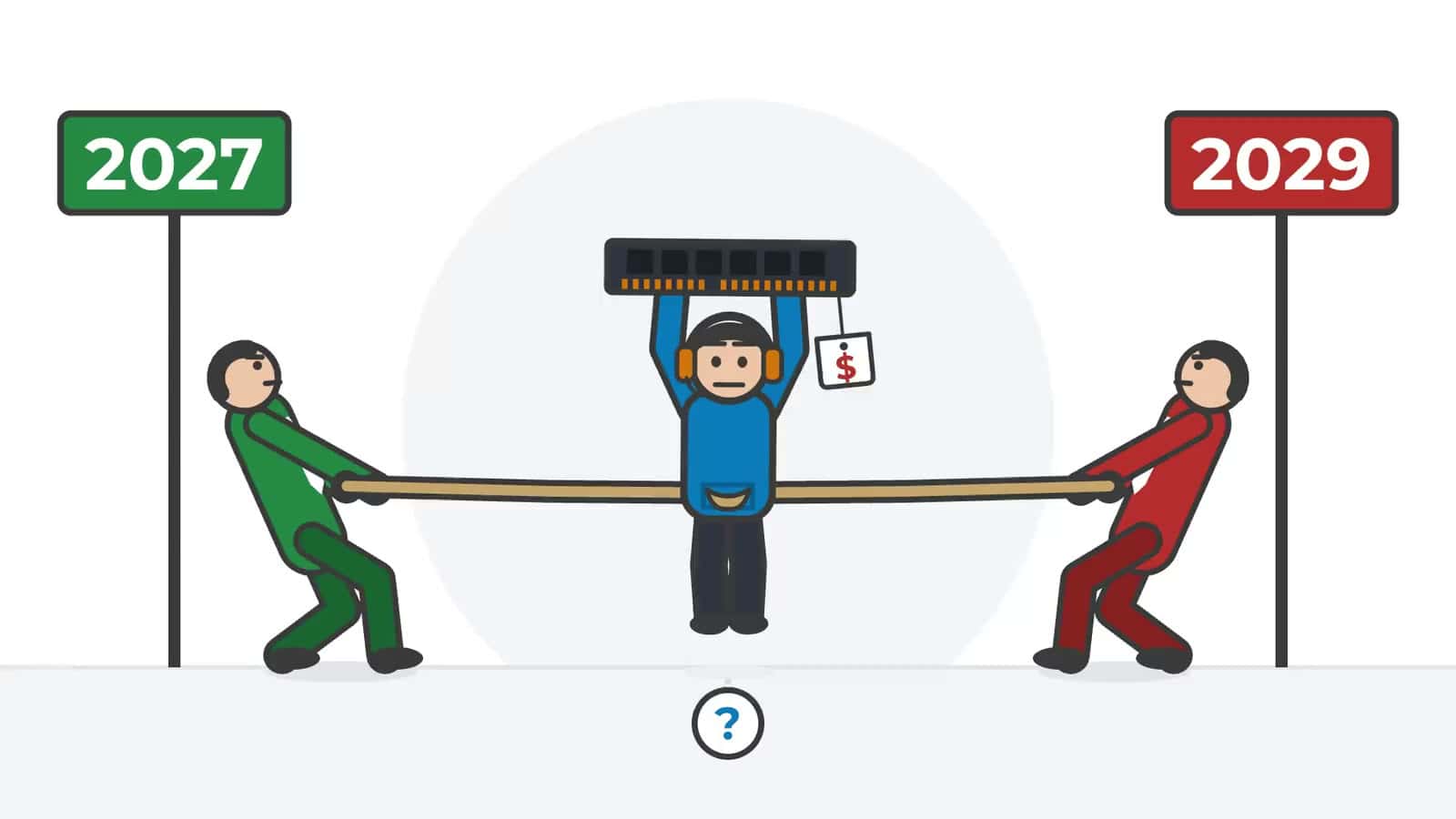
A 32GB DDR5 kit that sold for under $100 last summer now costs around $480, and a 64GB kit costs more than a PlayStation 5. Everyone with a build, an upgrade, or a holiday laptop decision pending is stuck deciding whether to buy now or wait.
This week, two hardware CEOs gave opposite answers: one on an earnings call, the other in the press. Chen Ching-wen, CEO of memory module maker Team Group, told investors on November 2 that the shortage gets worse through 2027, that supply and demand will not balance until the second half of 2028 “or perhaps even later,” and that budget components will not ease until 2029. Some purchasers, he said, face a scenario where “even money can’t buy goods” (Tom’s Hardware, HotHardware).
Jason Chen, chairman of PC maker Acer, publicly predicts the reverse: PC prices rise a final 5% to 20% through the end of 2026, plateau in the first half of 2027, and start falling after mid-2027. His explanation is an accusation: memory makers are deliberately stretching out the shortage story to protect the margins the AI boom handed them. “It’s impossible for the shortage to last until 2030,” he said (PCMag, Notebookcheck).
Both men run companies that profit from which version you believe. Neither forecast counts as evidence until you check the incentives and the physics behind it.
Seven forecasts
Every major memory supplier, one analyst house after another, and a few module makers have gone on record. Their end dates span 2027 to 2036.
Who says the RAM crunch ends when
Public forecasts as of November 2026, placed by the date each speaker puts relief or balance. Bars indicate an open-ended “beyond” claim.
Samsung, SK hynix, and Micron keep saying the crunch lasts years, because they are the ones charging for it. Acer keeps saying relief is near, because it is the one paying. Team Group sits in the middle as a module maker, and its CEO lands on the pessimistic side while his own company posts a record quarter.
What you are paying right now
Before weighing the forecasts, anchor them to the damage. Tom’s Hardware tracks the lowest U.S. retail price on common DDR5 kits and compares each one to the lowest price it has ever recorded. As of early November 2026, mainstream kits sit at roughly six times their all-time lows, and high-capacity kits are far worse.
Current best U.S. price versus the lowest price ever tracked
DDR5 kits, from Tom’s Hardware’s RAM price index, early November 2026. The vertical tick on each bar marks the all-time low.
The one-year change is just as telling. PCPartPicker average prices, pulled by Tom’s Hardware in August, show every tier of the market multiplied between four and six times in twelve months. Even DDR4, the supposed budget refuge, is up 159% at the entry level.
One year of DDR5 price damage
Average U.S. kit prices, August 2025 versus August 2026 (PCPartPicker data via Tom’s Hardware).
At the chip level, the number both camps agree on is this: the contract price of a 16Gb DDR5 chip climbed from $8.70 in October 2025 to $48 by September 2026. That is roughly 5.5× in twelve months, cited by Team Group’s CEO on his earnings call and reported by BigGo Finance.
Why both men have a reason to shape their story
Each one is paid to see a different future, and each forecast does double duty as a business move.
The incentive scorecard
| Speaker | What they sell | Their forecast | What they gain if you believe it | What complicates the story |
|---|---|---|---|---|
| Chen Ching-wen Module maker |
RAM kits (Team Group) | Worse through 2027, balance H2 2028+, budget parts 2029 | Panic marks up his inventory, pre-justifies the 30–40% quarterly hikes he predicts, and shifts blame for high retail prices onto chip suppliers | He is also squeezed: Team Group has contracts but must buy extra supply at a 30–50% spot premium. He owns no fab, so he cannot manufacture the shortage |
| Jason Chen PC vendor |
Laptops, desktops (Acer) | Prices plateau H1 2027, fall from late 2027; shortage is hyped | Keeps frozen buyers in the market, resists supplier price hikes in negotiations, and positions Acer as the consumer’s champion | Acer raised its own prices in February 2026. Telling buyers to hold out for late 2027 also invites them to stop buying now, which hurts his current quarters |
| Mehrotra, Kim, SK hynix Chip sellers |
DRAM and HBM (Micron, Samsung, SK hynix) | Tight through 2028 (Micron: 2027 and 2028 “much tighter”); SK hynix: through 2030 | A durable scarcity narrative sustains record pricing power, multi-year contracts, and stock valuations | They are also the defendants in a June 2026 class action alleging a coordinated shift to HBM was used to curtail consumer DRAM output. “Structural demand” is both their forecast and their legal defense |
| Chen Li-Bai Module maker |
RAM kits (ADATA) | Shortage for “the next 10 years”; AI bubble can wait until 2040 | The longest timeline in the debate marks up inventory hardest of all | He is a buyer of chips like Team Group, yet far more bullish, which shows module makers are not unified on one story |
History says to discount all of them. DRAM is the most cyclical product in semiconductors, and its executives have a consistent record of calling peaks permanent. Between June 2016 and January 2018, DRAM prices nearly tripled; suppliers and analysts then warned of continued tightness, and contract prices fell roughly 30% in the first quarter of 2019 alone once buyers stepped back (Wikipedia’s account of the 2018 class action, EE Times). The industry carries convictions here too. In 2002, Samsung, Hynix, Infineon, and others pleaded guilty to a four-year price-fixing conspiracy, with fines totaling more than $645 million in the U.S. plus €331 million from the EU in 2010. That record is worth remembering whenever memory makers attribute high prices to market forces.
One correction in favor of the pessimists, though: for twelve straight months, the chip sellers have been right. Micron CEO Sanjay Mehrotra said in December 2025 that his company could meet only “half to two-thirds” of key-customer demand, and prices rose all year anyway. Acer-style optimism has been wrong every quarter since the shortage began.
The supply evidence picks a side
When supply rebalances comes down to one physical factor: how fast the world can make more DRAM. The answer is uncomfortably slow, and the reasons compound.
Why new supply cannot arrive before 2028
Acer’s named catalyst, China’s CXMT, does not change the arithmetic. CXMT plans to grow monthly capacity from about 320,000 wafers to 420,000 by 2027, a gain of 100,000 wafers that is largely absorbed by China’s own AI and cloud buildout, per TrendForce’s September report. CXMT holds about 9.5% of global DRAM revenue, and its expansion is aimed at replacing China’s imports rather than flooding export markets. On our estimate, even if every new CXMT wafer reached Western buyers, the addition would cover only a fraction of the roughly 13% shortfall IDC projects for late 2027. Chinese supply helps at the margin, far short of the rescue Jason Chen describes.
On supply, then, the evidence backs Team Group’s CEO. Nothing in the fab schedule, the contract books, or the analyst models puts chip supply and demand in balance before the second half of 2028. The data answers Chen Ching-wen’s question “How can prices fall when there’s nothing left?” in his favor.
How Jason Chen can still be right
Retail prices do not need supply to rebalance in order to fall. They need buyers to stop buying. Every past DRAM cycle ended with buyers walking away, and that part has started.
PC shipments will decline 11.3% in 2026, with Q4 projected down 20% year over year, according to IDC figures cited by PCMag. Apple’s iPad revenue fell 10% partly on supply constraints even as it stockpiled memory hard enough to push inventory up 154% year over year and add $33 billion in purchase commitments in a single quarter (TechCrunch). TrendForce expects consumer electronics shipments to decline again in 2027 as higher prices suppress replacement demand. Even the pace of contract price increases is decelerating: TrendForce projects conventional DRAM contract prices up 10–15% quarter over quarter in Q4 2026, slower than prior quarters.
The 2019 precedent shows how fast that dynamic flips. After the 2016–2018 spike, contract prices did not drift down gently; they fell about 30% in a single quarter as server buyers worked through inventory and walked away. If $480 RAM kits keep killing PC demand through 2027, module makers will eventually be sitting on kits nobody wants, and Jason Chen’s plateau becomes real, on the retail shelf, while chip fabs remain sold out behind it.
The two CEOs are describing different halves of the same market. Chen Ching-wen is talking about chips: tight until at least late 2028, corroborated by everyone who counts wafers. Jason Chen is talking about the sticker on your kit: peaking sometime in 2027 because buyers are breaking, whether or not supply ever catches up. Both can be true, and both probably are.
So when does RAM get cheap again?
The debate feels unsolvable because three different milestones keep getting conflated.
Three paths for a 32GB DDR5 kit, from published forecasts
Starting point: roughly $422, the current best U.S. price on a DDR5-5600 32GB kit. Scenarios derived from the CEOs’ own stated assumptions; each line sketches a range of outcomes instead of a single forecast.
The honest answer to the headline question
The worsening most likely stops in the second half of 2027. Both camps converge there: Acer says prices plateau, Team Group says the shortage peaks between now and mid-2027, and TrendForce already shows the rate of contract increases slowing.
Prices fall first at retail, plausibly late 2027 into 2028. That drop comes from collapsing consumer demand rather than new supply. At the chip level the wait is longer: IDC, TrendForce, and every fab schedule on record put the earliest relief in the second half of 2028.
Cheap like 2025: probably not for years, and maybe never at the old lows. Team Group itself dates budget-part relief to 2029, and the AI demand floor that caused this crisis does not disappear when supply catches up.
How to buy RAM in a shortage
With Black Friday on November 27 and the doom scenario carrying a real probability, the decision rule rests on your use case.
Buy, wait, or sidestep
How you will know the turn is coming
Whichever CEO you believe, the numbers move before either man changes his story. These are the indicators that have led past turns, and what a genuine signal looks like for each.
The turn-detection watchlist
| Indicator | Where to look | Current reading | The signal that relief is real |
|---|---|---|---|
| Quarterly contract price increases | TrendForce press releases, four times a year | +10–15% projected for Q4 2026, already slowing | A quarter below roughly +5%: the rate of increase has broken |
| Spot-to-contract spread | Team Group commentary; TrendForce spot data | Spot runs 30–50% above contract | The spread narrowing toward zero means panic buying is ending |
| Supplier fulfillment language | Micron, Samsung, SK hynix earnings calls | Micron can meet “half to two-thirds” of key demand | Any major supplier saying it can meet all orders |
| CXMT going global | Product announcements, TrendForce share data | 9.5% revenue share; expansion serving China first | Chinese kits appearing in Western retail at discount |
| AI capex wobble | CSP earnings guidance, HBM order revisions | Record capex; some providers report negative free cash flow (per TrendForce) | Any hyperscaler cutting memory procurement; TrendForce calls this the key variable |
| Retail floor | Tom’s Hardware RAM index | Still rising month over month | Two consecutive months of falling best prices on 32GB kits |
Until those lights change, the working assumption is that RAM is not getting cheaper next quarter, it may stop getting worse during 2027, and it will not feel like 2025 again before the end of the decade. Two CEOs gave you opposite answers this week because they are selling opposite outcomes. Buy based on your own deadline.
Sources
- Tom’s Hardware: Team Group CEO warns memory crisis could reach point where “even money can’t buy goods” (Nov 4, 2026)
- HotHardware: Apple and Team Group reveal when the memory crisis will hit peak pain (Nov 3, 2026)
- PCMag: Despite doomsday predictions, this CEO thinks RAM crunch will end in late 2027 (Sep 22, 2026)
- Notebookcheck: Acer CEO says memory makers are hyping the 2030 shortage (Sep 23, 2026)
- TechCrunch: Apple’s inventory surges 154% as memory chip costs climb (Nov 2, 2026)
- Tom’s Hardware: Micron outlines grim outlook for DRAM supply (Dec 2025)
- TrendForce: AI server demand sustains memory contract price increases in 4Q26 (Sep 30, 2026)
- TrendForce: Diverging memory market outlook in 2027 (Jul 30, 2026)
- Gate News: IDC pushes memory market inflection point to 2028 (Jul 14, 2026)
- TrendForce: CXMT, YMTC ramp memory capacity, but China’s AI boom could soak up new supply (Sep 24, 2026)
- Tom’s Hardware: Memory prices climb 500% in 12 months (Aug 17, 2026)
- Tom’s Hardware: RAM price tracking 2026 (updated regularly)
- The Verge: RAM shortage live tracker
- Wccftech: ADATA chairman warns DRAM shortage will last another 10 years
- Wikipedia: DRAM industry price fixing (2002 cartel, 2018 suit, June 2026 suit)
- EE Times: DRAM prices drop 30%, exceeding Q1 2019 forecasts
- SemiAnalysis: Memory Mania, a once-in-four-decades shortage (Feb 6, 2026)
Figures marked “our analysis” (the fan-chart scenarios and the CXMT shortfall estimate) are our own constructions from the cited inputs; every price, quote, and date elsewhere links to its source. Prices reflect U.S. retail as of early November 2026 and move daily.